




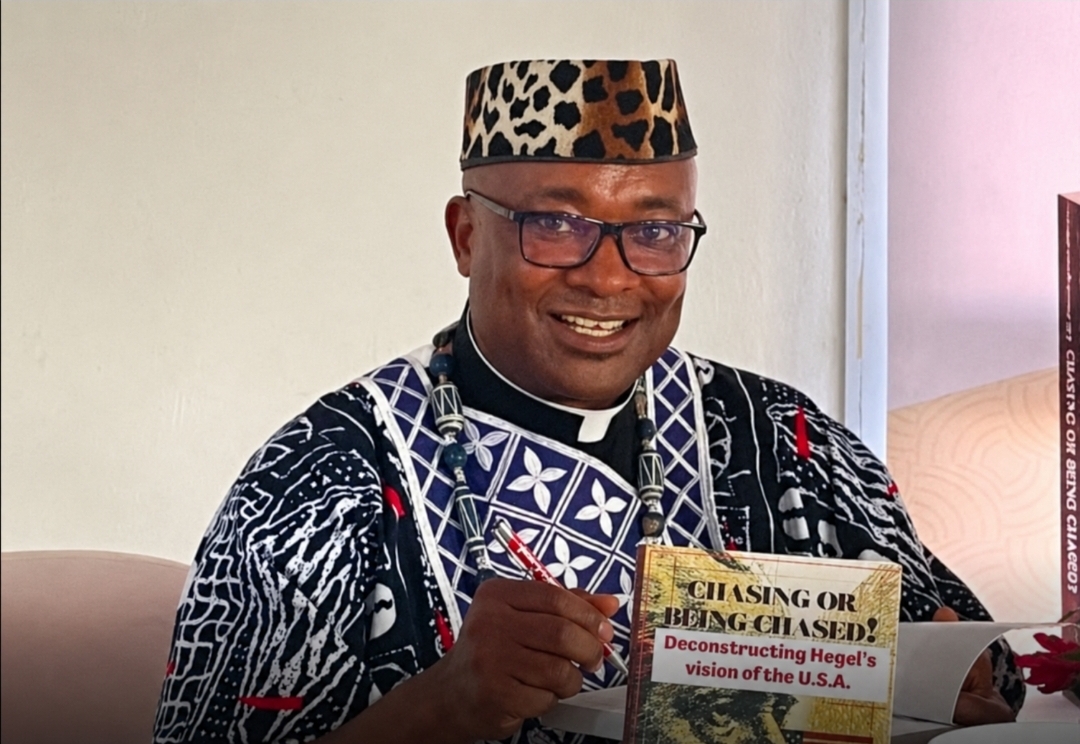
Can Africa become a land of opportunity for its own youth? This was one of the central questions raised on Friday, July 31, 2026, at Saint Louis Catholic Church in Bonabéri, during the presentation and dedication of Cameroonian author Basile Sede Noujio’s latest book, “Chasing or Being Chased? Deconstructing Hegel’s Vision about the USA.”
The book presentation, organized as an international conference, brought together academics, economists, Christian intellectuals, religious leaders and members of the literary community. Beyond the unveiling of a new publication, the event provided a platform for debate on one of Africa’s most pressing challenges: the continuous departure of young people in search of better opportunities abroad.
Between chasing opportunities and escaping hardship
In his book, Basile Sede Noujio explores the different realities behind African migration to the United States and the wider Western world.
For some young Africans, migration represents the pursuit of education, employment, professional growth and a better quality of life. For others, leaving the continent is less a choice than an escape from unemployment, poverty, insecurity and a perceived absence of prospects.
This dual reality lies at the heart of the author’s reflection. The question is not simply why Africans leave, but also why their societies have not yet succeeded in creating enough opportunities to convince them to stay.
Challenging the “land of opportunity” narrative
One of the book’s major contributions is its critical examination of the philosophical narrative associated with German thinker Georg Wilhelm Friedrich Hegel and the perception of the United States as a land of possibilities and opportunities.
Basile Sede Noujio challenges this perception by arguing that opportunity and happiness should not be associated exclusively with the West.
For the author, there is nothing inherently preventing Africa from becoming a continent where young people can build successful lives. The real challenge, he suggests, is to create the political, economic and social conditions necessary for that transformation.
His argument therefore goes beyond a criticism of migration. It is a call to rethink Africa’s development model.
Africa must become a creator of opportunities
The author’s message is particularly directed at a generation of young Africans who often see migration as the most realistic path toward success.
Rather than allowing young people to constantly chase opportunities elsewhere, Basile Sede Noujio argues that African countries must create the conditions for opportunities to emerge locally.
Education, employment, entrepreneurship, innovation and economic development should no longer be considered secondary priorities. They must become central pillars of a strategy aimed at giving young Africans a genuine reason to remain on the continent.
In this perspective, Africa’s development cannot depend entirely on external assistance or imported solutions. Africans must increasingly become the architects and creators of their own opportunities.
A book that sparks debate
The presentation of “Chasing or Being Chased?” generated significant intellectual exchanges. Speakers from different backgrounds shared their perspectives on migration, development, economic opportunities, the role of faith and the future of African youth.
A lively question-and-answer session further enriched the event, allowing participants to engage directly with the author and other speakers. The discussions offered the audience a deeper understanding of the issues explored in the book and highlighted the complexity of the choices facing young Africans today.
The event concluded with a book-signing session, bringing the day’s discussions to a close.
Ultimately, “Chasing or Being Chased? Deconstructing Hegel’s Vision about the USA” presents itself as more than a reflection on the United States or African migration. It is a call for a profound change in mindset.
The message from Basile Sede Noujio is clear: Africa should no longer be a continent whose young people must leave in order to find opportunity. It must become a continent capable of creating those opportunities itself