


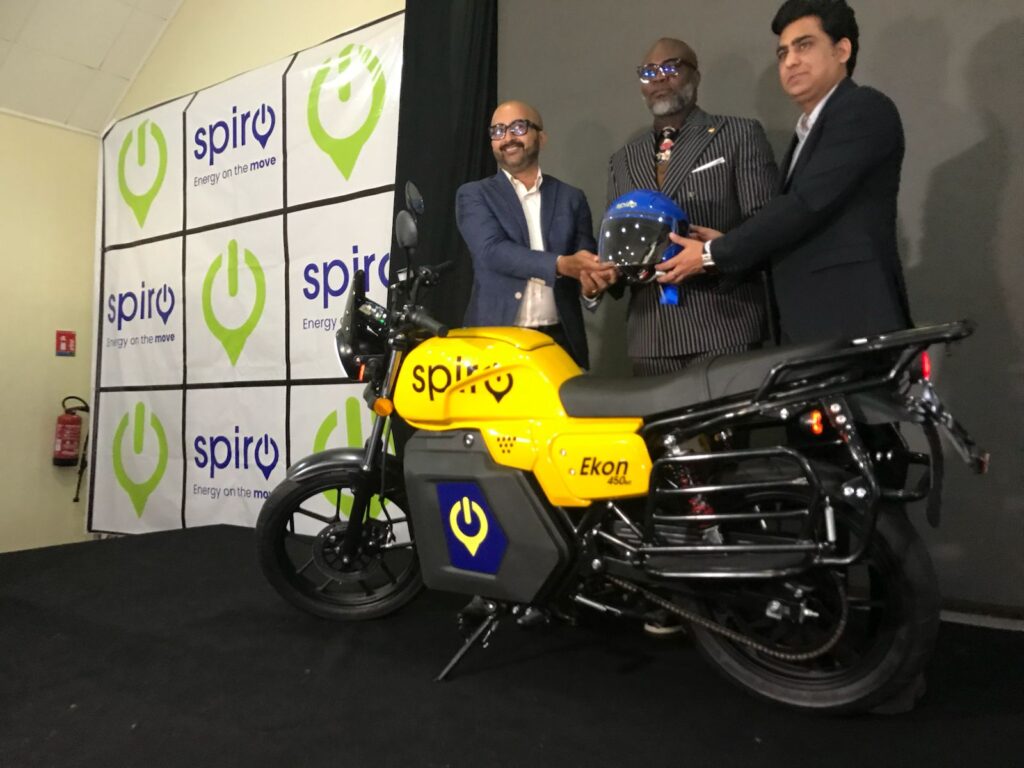
A new era of transportation has arrived in Cameroon. On Saturday, May 10, Spiro, Africa’s leading electric motorbike and vehicle company, officially launched its franchise in Douala, the country’s economic capital. For many at the launch event at the Sawa Hotel, the moment felt like a scene straight out of a comic book. Spiro’s electric motorbike, described as a “superhero bike,” wowed the crowd with features previously seen only in futuristic films.

High-Tech, Fuel-Free, and Theft-Proof
Spiro’s electric motorbike comes with a host of innovative features: it runs entirely without fuel, boasts theft-resistant technology, and slashes operating costs by more than half compared to conventional bikes. Described as a “high-definition bike,” it is being hailed as the future of mobility across Africa.“It’s like something from a superhero movie,” said one attendee. And indeed, Spiro’s arrival may be the game-changer Africa’s transport industry has been waiting for.
Cameroon: Spiro’s Seventh Frontier
With Cameroon becoming Spiro’s seventh country of operation—following Togo, Benin, Nigeria, Kenya, Uganda, and Rwanda—the company is solidifying its Pan-African footprint. Since its founding in 2019, Spiro has grown into a major player in the continent’s green mobility revolution.
According to CEO Kaushik Burman, the company’s mission is to promote electric mobility while supporting local industrial development—a vision that aligns with Cameroon’s own goal of building a local automotive industry.
Government Incentives Fuel Growth
Under the country’s 2025 Finance Law, electric vehicles are now exempt from the 12.5% excise tax. Furthermore, new electric bikes, batteries, and charging stations will enjoy a 50% reduction in taxable value for 24 months, creating a favorable climate for electric mobility investors.
Starting in July 2025, Spiro will roll out an initial 100 electric motorbikes in Douala, accompanied by a network of battery swap stations, placed every 3 kilometers to address concerns about range and battery autonomy.
“We estimate users will spend only CFA 1,500 to travel 100 kilometers—a significant saving compared to fuel-powered motorcycles,” said Rahul Gaur, Spiro’s General Manager for West Africa and Cameroon.
Local Assembly and Job Creation
In its second phase, Spiro plans to establish a motorbike assembly plant in Cameroon, a move that will not only meet growing demand but also create hundreds of direct and indirect jobs. Each battery swap station is expected to employ about 3.5 people, while the factory and planned maintenance centers will hire local engineers and technicians, fostering technology transfer and industrial skill development.
Industry Stakeholders Voice Support
Ferdinand Fongang, national president of Grassmota, attended the launch and voiced strong support for the project:“When I compare fuel consumption, I find the electric two-wheeler to be better. We will test these bikes and return with on-the-ground feedback for improvement,” he stated.
A Continental Force in Motion
With over 3 million electric motorbikes in circulation across Africa and more than 341 million kilometers already covered, Spiro is proving that clean, affordable, and efficient mobility is not just a dream—but a rapidly growing reality. Its entry into Cameroon and the CEMAC region marks another bold step toward transforming transportation across the continent.